Try a Free Class →

The Art

What is Aikido?

Aikido is a modern Japanese Budo — a Martial Way. Unlike martial arts focused primarily on defeating an opponent, a Budo is a discipline of self-cultivation: the martial techniques serve as the vehicle for developing character, integrity, and clarity of mind.

Modern Aikido was formalized by Master Morihei Ueshiba in the first half of the twentieth century, drawing from Jujitsu, Kenjutsu, and Aikijutsu while adding a philosophical dimension those older arts did not possess. Aikido teaches no forms of attack or aggression. Students practice many forms of attacking, but only as a means of helping fellow practitioners master the Aikido techniques and develop their own skill.

An Aikidoka — one who dedicates themselves to learning Aikido — learns to use the minimal amount of physical force, and the maximal amount of intellect, to defuse an attack and eliminate a potential threat. The result is a discipline that is as much about personal development as it is about self-defense.

Budo — The Martial Ways

Aikido belongs to a broader family of Japanese martial disciplines. Some are armed, others unarmed — all share the goal of building character through rigorous practice.

  • Aikido合気道Unarmed
  • Judo柔道Unarmed
  • Karate空手Unarmed
  • Kendo — swordsmanship剣道Armed
  • Kyudo — archery弓道Armed
  • Bojutsu — staff棒術Armed
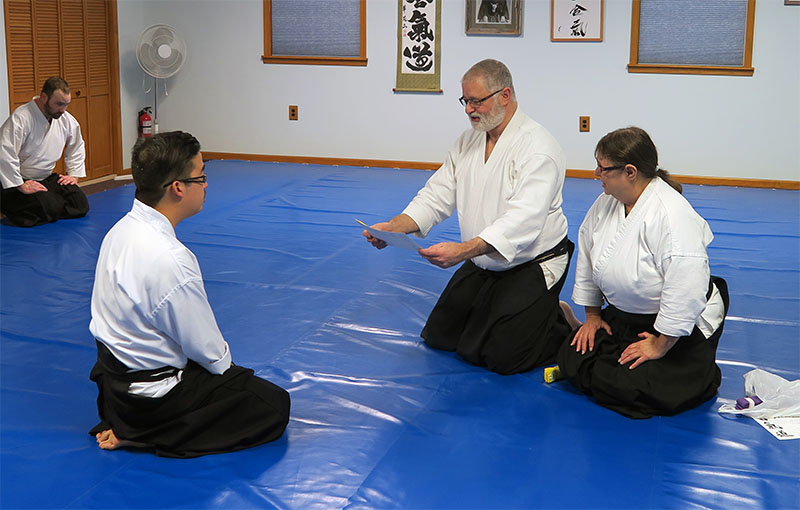
Aikidoka from the Prairie Aikikai

Aikidoka from the Prairie Aikikai

The Founder

Morihei Ueshiba

Morihei Ueshiba, founder of Aikido
Morihei Ueshiba 植芝 盛平 December 14, 1883 – April 26, 1969

Aikido was formalized as a modern martial art during the first half of the twentieth century. Tracing roots back over 700 years, this method of Budo was refined by Master Morihei Ueshiba. O'Sensei — Great Teacher, as he is now known — was born on December 14, 1883 in Tanabe, Wakayama Prefecture, Japan. While young he studied sumo wrestling and swimming to improve his slight frame. In 1901 he moved to Tokyo, setting up his own stationery and school supply store. It was there he first began to study the martial arts, learning jujitsu and kenjutsu.

Morihei spent 1903 through 1907 fighting in the Russo-Japanese War. After returning to civilian life he studied with Sokaku Takeda, master of Daito-ryu, eventually earning a certificate in Daito-ryu jujitsu. In mid-November 1919, traveling home to Tanabe to see his ailing father, he detoured through Ayabe where he encountered the religion Omoto-kyo, renowned for its meditation techniques that “calmed the spirit, returning it to the divine.” His father passed away in January 1920, and the grieving Morihei returned to the Omoto-kyo leader Onisaburo Deguchi, spending the next eight years there in pursuit of a more spiritual life — converting part of his home into an eighteen-mat dojo.

It was during this period that his martial arts began to take on a deeper spiritual character. By 1922 his approach was known as aiki-bujutsu. In 1924 he joined an ill-fated expedition to Manchuria and was only returned to Japan through the intervention of the Japanese consulate. After his return he developed a refined intuitive sense of knowing where an attack was coming from before it arrived.

The spring of 1925 proved to be transformative. He met the challenge of a naval officer, a master of Kendo, defeating him without once being touched — anticipating and evading each attack as it came. Afterward, at a well, he later described “being bathed in a golden light pouring down from the heavens,” a moment of complete serenity of body and spirit that led him to the philosophical principles upon which modern Aikido is based. He renamed his art aiki-budo.

By 1927 Morihei had moved to Tokyo to devote all of his energies to teaching. In April 1931 a full-scale, eighty-mat dojo was inaugurated. Aiki-budo flourished over the next decade, attracting students from all walks of life. It was during the disruption of World War II that the term Aikido was first used. After the war, on February 9, 1948, the Ministry of Education granted permission for the reestablishment of the Aikikai. Headquarters moved to Tokyo in 1954 as the Aikikai Foundation: The Hombu Dojo of Aikido.

January 12, 1968 saw the completion and commemorative ceremony of the new three-story Hombu Dojo building. Later that year O'Sensei gave what would be his last public demonstration. Morihei Ueshiba passed away peacefully on April 26, 1969, at the age of 86.
The Philosophy

Four Levels of Ethical Combat

Modern Aikido draws much of its form from the older arts of Jujitsu, Kenjutsu, and Aikijutsu. In their original forms these techniques can be quite damaging, even deadly. Aikido, as an art of self-protection, takes a different path. This distinction is best captured in four levels of ethical self-defense, drawn from Westbrook and Retti's Aikido and the Dynamic Sphere — a framework that defines what separates Aikido from every other martial art.

Level One — The Lowest Form

Unprovoked Attack

A man, without provocation and entirely on his own initiative, attacks another and kills him. He has no respect for the life of another, and none for the martial training he has received. This is the most base expression of force.

Level Two

Provoked Response

The man invites an attack — through an insult or gesture — then kills the one he provoked. He is not guilty of initiating the attack, but is fully responsible for inciting it. The end result is still a person killed, and the ethical distinction from the first level is narrow.

Level Three

Defensive Injury

The man neither attacks nor provokes. When assaulted, he defends himself — but does so in a way that injures his attacker, perhaps seriously. Ethically this is more defensible than the first two levels, but his method of self-protection still results in harm to another person.

Level Four — The Goal of Aikido

Mastery Without Harm

Neither attacking nor provoking, each practitioner learns to defend themselves with such skill and control that the attacker is neither killed nor seriously injured. This is the beauty of the Budo developed by Master Ueshiba — the resolution of a conflict in which everyone walks away.

Ready to step on the mat?

Your first two classes are free. No membership required. Just show up.

Contact Us & Visit